If you run a small business or plan to start one, understanding MSME Classification is very important. Many entrepreneurs focus only on registration but ignore how their business is categorised.
Your business category determines compliance requirements, growth strategy, financial planning, and eligibility under various schemes, which is why many businesses seek professional help through MSME registration consultancy services from Vivek Tiwari & Co.
In this guide, we explain MSME Classification in simple terms so every business owner can understand it clearly.
Understanding MSME Classification is crucial for business owners because it directly impacts compliance, growth, and eligibility for schemes.MSME Classification refers to the system used by the Government of India to categorise businesses into:
- Micro
- Small
- Medium
This categorisation is based on two financial factors:
- Investment in plant & machinery or equipment
- Annual Turnover
Earlier, only investment was considered. Now, both investment and Turnover are used together to determine proper classification.
The current criteria for MSME Business Classification are important because they reflect recent government updates that affect how your business is categorised. The Government revised the classification rules to create a uniform structure for manufacturing and service businesses.
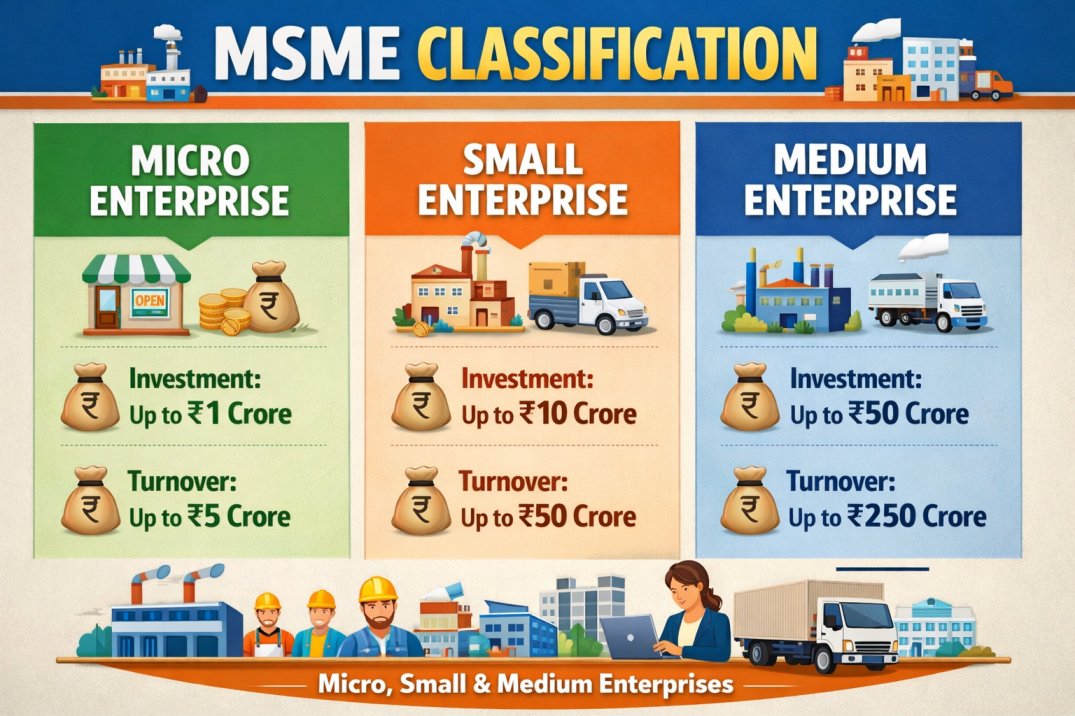
MSME Categorization Table
| Category | Investment Limit | Annual Turnover Limit |
| Micro Enterprise | Up to ₹1 Crore | Up to ₹5 Crore |
| Small Enterprise | Up to ₹10 Crore | Up to ₹50 Crore |
| Medium Enterprise | Up to ₹50 Crore | Up to ₹250 Crore |
Both conditions must be satisfied to remain in a particular category.
For example:
If your investment is within the Small limit but Turnover crosses ₹50 crore, your business will move to the Medium category.
Proper MSME business classification helps in:
Many business owners assume categorisation is just a formal requirement. Clarifying its importance can help you feel more confident in managing your compliance and growth.
Why MSME Classification Matters
- Clear financial planning
- Better growth tracking
- Understanding the compliance level
- Determining reporting obligations
- Structuring an expansion strategy
As your business grows, your classification may change automatically based on financial data.
How Investment is Calculated
For MSME categorisation:
- Only plant, machinery, and equipment are considered
- Land and building costs are excluded.
- GST data and Income Tax returns are generally used for verification
This makes the system transparent and data-driven.
How Turnover is Calculated
- Turnover is the total sales revenue for a financial year.
- Export turnover is excluded while calculating limits.
- GST filings help determine Turnover automatically
This ensures accuracy and prevents manual errors.
Upward and Downward Reclassification
MSME Classification is dynamic.
Upward Movement
If your investment or Turnover crosses the limit, your enterprise moves to the next category.
Downward Movement
If your Turnover falls below the threshold for one year, reclassification may occur.
This system ensures that businesses are categorised fairly based on their actual financial performance.
Common Mistakes in MSME Categorisation
Many businesses face issues due to:
- Incorrect reporting of Turnover
- Miscalculation of machinery value
- Ignoring export exclusion rules
- Not reviewing classification annually.
- Assuming service and manufacturing have separate limits (they do not anymore)
Understanding the correct structure avoids future compliance complications.
Difference Between Old and New MSME Classification
Earlier system:
- Separate limits for manufacturing and service businesses
- Only investment criteria considered
- Lower threshold limits
Current system:
- Uniform criteria for all sectors
- Investment + Turnover are both considered.
- Higher limits to encourage growth
This change was introduced to promote business expansion without losing MSME status too quickly.
Understanding how MSME classification affects business growth is vital because it shapes expansion plans, investment decisions, and tax strategies. Proper classification helps in:
- Strategic expansion planning
- Structuring capital investment
- Evaluating turnover growth
- Managing tax planning effectively
- Preparing for scale-up
Businesses close to threshold limits should carefully plan investments and revenue growth to avoid unexpected category changes.
You should review your classification at the end of every financial year or before major changes to stay in control and ensure compliance. You should review your classification:
- At the end of every financial year
- Before major machinery investment
- Before raising capital
- Before expanding operations
- If Turnover is rapidly increasing
Regular review ensures compliance stability.
At Vivek Tiwari & Co, we assist businesses in ensuring their classification is accurate, helping you feel supported and confident in your compliance. At Vivek Tiwari & Co, we assist businesses in:
- Correct evaluation of investment figures
- Turnover analysis based on GST & ITR
- Category assessment before expansion
- Compliance planning based on classification
- Advisory on transition from Micro to Small or Small to Medium
We ensure that your MSME Classification aligns correctly with your financial data and future business goals.
For businesses already registered, we also suggest reviewing your existing categorisation periodically to avoid compliance risks.
Conclusion
Understanding MSME Classification is essential for every growing business in India. It is not just about registration; it is about correct categorisation based on financial performance. Proper MSME business classification helps you stay compliant, plan growth effectively, and avoid regulatory issues. If you are unsure about your current MSME categorisation or planning expansion, taking professional guidance from Vivek Tiwari & Co can help you make informed decisions, ensure accurate classification, and position your business for sustainable growth..
FAQs on MSME Classification
1. What is MSME Classification based on?
It is based on investment in plant & machinery and annual Turnover.
2. Is Turnover alone enough to determine the MSME category?
No. Both investment and Turnover must fall within the prescribed limits.
3. Does export turnover count in MSME categorisation?
Export turnover is excluded while calculating turnover limits.
4. Can a business move from Small to Micro?
Yes, if financial figures fall below the prescribed threshold, reclassification is possible.
5. Are manufacturing and service businesses classified separately?
No. The current system uses uniform limits for both sectors.